FloatChat
AI-Powered Conversational Interface for ARGO Ocean Data Discovery and Visualization
FloatChat - AI-Powered ARGO Ocean Data Discovery and Visualization
Overview
FloatChat is an intelligent conversational AI system that revolutionizes how researchers interact with ARGO float data. The platform addresses a critical gap in oceanographic research: making vast, complex datasets accessible, understandable, and actionable through natural language.
By combining a RAG-based AI chatbot with interactive data visualizations and real-time dashboards, FloatChat enables users to query complex oceanographic data conversationally and receive instant, context-aware insights with supporting visualizations.
The Problem
Working with oceanographic data, I discovered that researchers face significant barriers when accessing ARGO float measurements:
- •Complex data structures requiring specialized knowledge to navigate FTP repositories
- •Time-intensive queries through traditional interfaces and command-line tools
- •Lack of intuitive visualization tools for spatial and temporal ocean data
- •Steep learning curve for students and researchers new to oceanography
These challenges slow down critical research on ocean warming, salinity changes, and climate patterns. I built FloatChat to democratize access to oceanographic data by providing an intelligent, conversational interface that makes this data accessible to anyone.
Architecture & Technical Approach
FloatChat is built on a modern, scalable architecture designed for both performance and accuracy:
Core Components
RAG-Powered Chatbot
Leverages Groq LLM (Qwen2.5-32B) with Retrieval-Augmented Generation to provide accurate, context-aware responses. The system uses ChromaDB for efficient vector storage and PostgreSQL for structured float metadata.
Data Pipeline
Automated ingestion from ARGO global repositories (ftp.ifremer.fr) and Indian Argo Project (INCOIS). Custom data cleaning modules handle inconsistencies, while embedding modules process metadata for semantic search.
Interactive Dashboards
Built with Streamlit, featuring geographic float maps powered by Folium, time-series analysis, and vertical profile visualizations. Dashboards update dynamically based on user queries and selections.
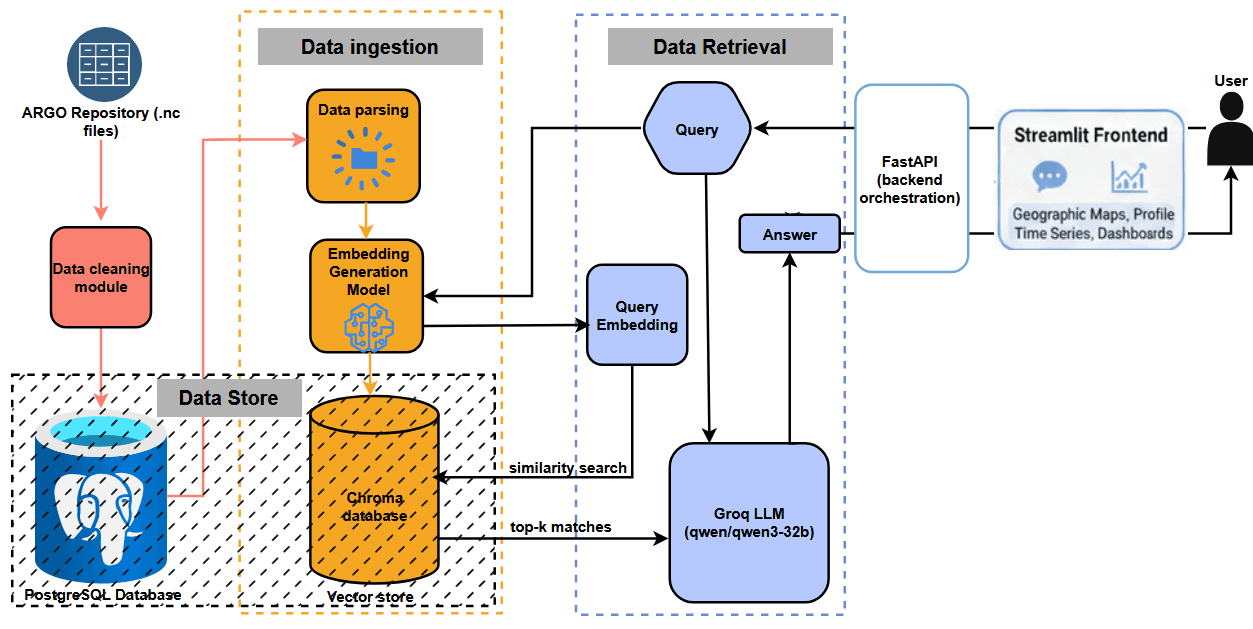
System architecture: data ingestion, RAG pipeline, and visualization layer
Backend API
FastAPI powers the backend with RESTful endpoints for data retrieval, query processing, and orchestration between the LLM, vector database, and visualization components. The API handles real-time similarity search and response generation with sub-second latency.
Key Features
💬 Natural Language Queries
Ask questions like "What were the average temperature values in the Central Indian Basin for 2016?" and get instant, accurate answers grounded in actual data sources.
🗺️ Interactive Float Maps
Visualize float locations geographically with fullscreen toggle. Select floats directly from the map interface for detailed analysis and metadata.
📊 Real-Time Dashboards
Dynamic visualizations for temperature, salinity, and pressure profiles. Time-series analysis with customizable date ranges and depth filters.
🔍 Context-Aware Responses
RAG architecture ensures responses are grounded in actual ARGO measurements with proper citations and supporting evidence from the database.
Challenges & Solutions
Data Volume & Processing Efficiency
Challenge: ARGO repositories contain millions of measurements spanning decades, requiring efficient ingestion, indexing, and retrieval.
Solution: Implemented incremental data loading with ChromaDB vector embeddings for semantic search and PostgreSQL for structured queries, achieving sub-second response times even with large datasets.
Accuracy & Hallucination Prevention
Challenge: Ensuring LLM responses are factually accurate and grounded in actual oceanographic data, not generated hallucinations.
Solution: RAG architecture retrieves relevant data before generation. Implemented similarity score thresholds and citation mechanisms that link responses directly to source measurements.
Visualization Performance
Challenge: Rendering thousands of geographic points and time-series data without performance degradation or UI lag.
Solution: Optimized Folium map rendering with clustering algorithms and lazy loading. Time-series charts use intelligent data aggregation for datasets exceeding display resolution.
Impact & Results
FloatChat demonstrates how AI can bridge the gap between complex scientific data and intuitive user interfaces:
Key Takeaways
• RAG architecture is essential for domain-specific AI applications where accuracy and source attribution are critical
• User experience matters in scientific tools—conversational interfaces can dramatically lower barriers to data access
• Combining multiple visualization types (maps, time-series, profiles) provides comprehensive insights that single-view tools cannot
• Performance optimization at both database and frontend levels is crucial when working with large scientific datasets